数据流分析--应用I
关键词
- may analysis vs must analysis
- forward analysis vs backward analysis
- Reaching Definitions Analysis
数据流分析(Data Flow Analysis)
OverView Of Data Flow Analysis
may analysis: outputs information that may be true(over-approximation)
must analysis:outputs information that must be true (under-approximation)
Over- and under-approximations are both for safety of analysis
different data-flow analysis applications have different data abstraction and different flow safe-approximation strategies. different transfer functions and control-flow handlings
Preliminaries of Data Flow Analysis
- Input and Output States
- Each execursion of an IR statement transforms an input state to a new output state.
- The input(output) state is associated with thee program point before (after) the statement.
In each data-flow analysis application, we associate with every program point a data-flow value that represents an abstraction of the set of all possible program states that can be observed for that point.
The set of possible data-flow values is the domain for this application.
Data-flow analysis is to find a solution to a set of safe-approximation directed constraints on the IN[s]’s and OUT[s]’s, for all statements s.
- constraints based on semantics of statements (transfer functions)
- constraints based on the flows of control
Transfer Function
Forward Analysis 前向分析
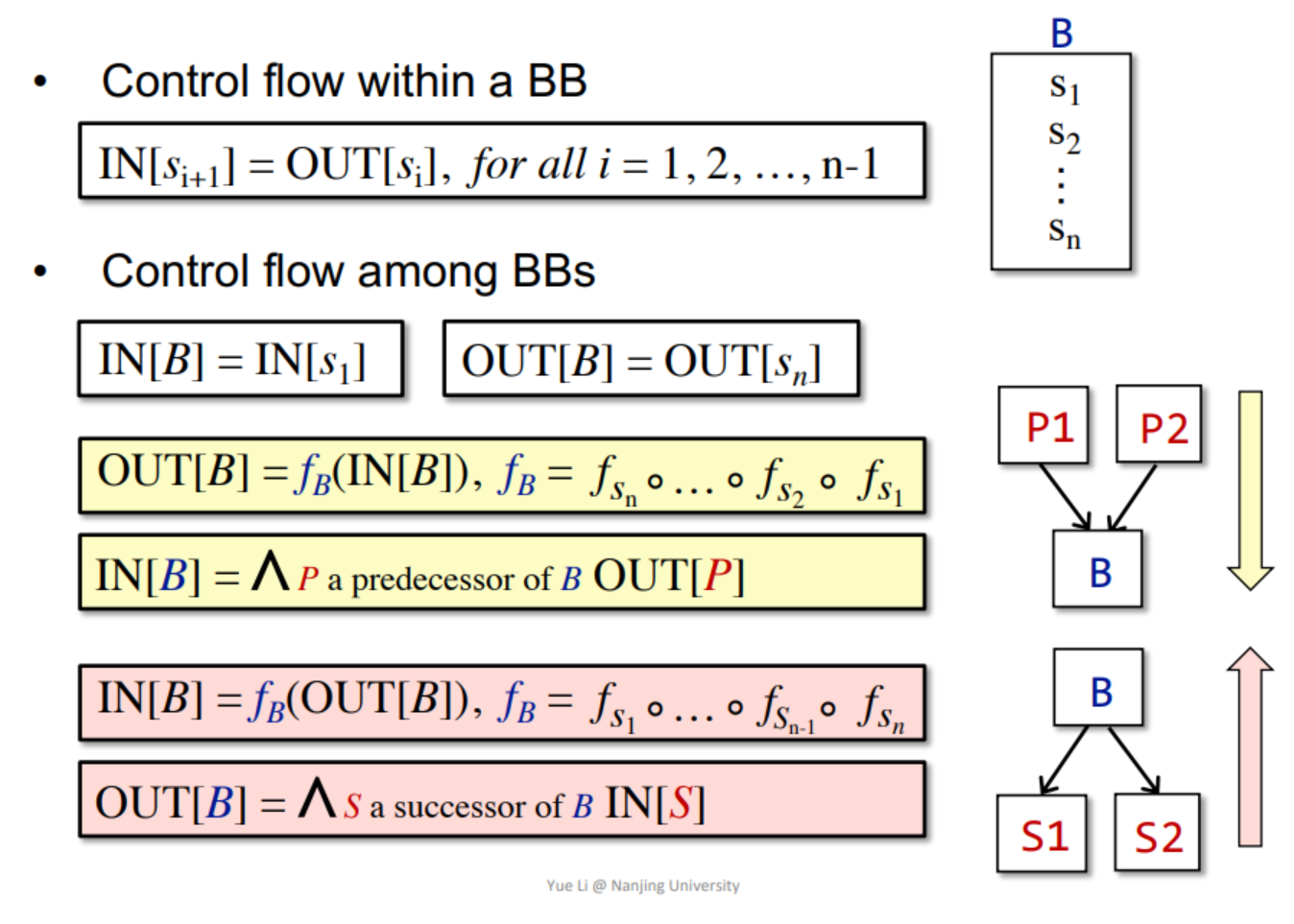
- OUT[s] = fs(IN[s])
Backward Analysis 后向分析
- IN[s] = fs(OUT[s])
Control Flow‘s Constraints
Reaching Definitions Analysis
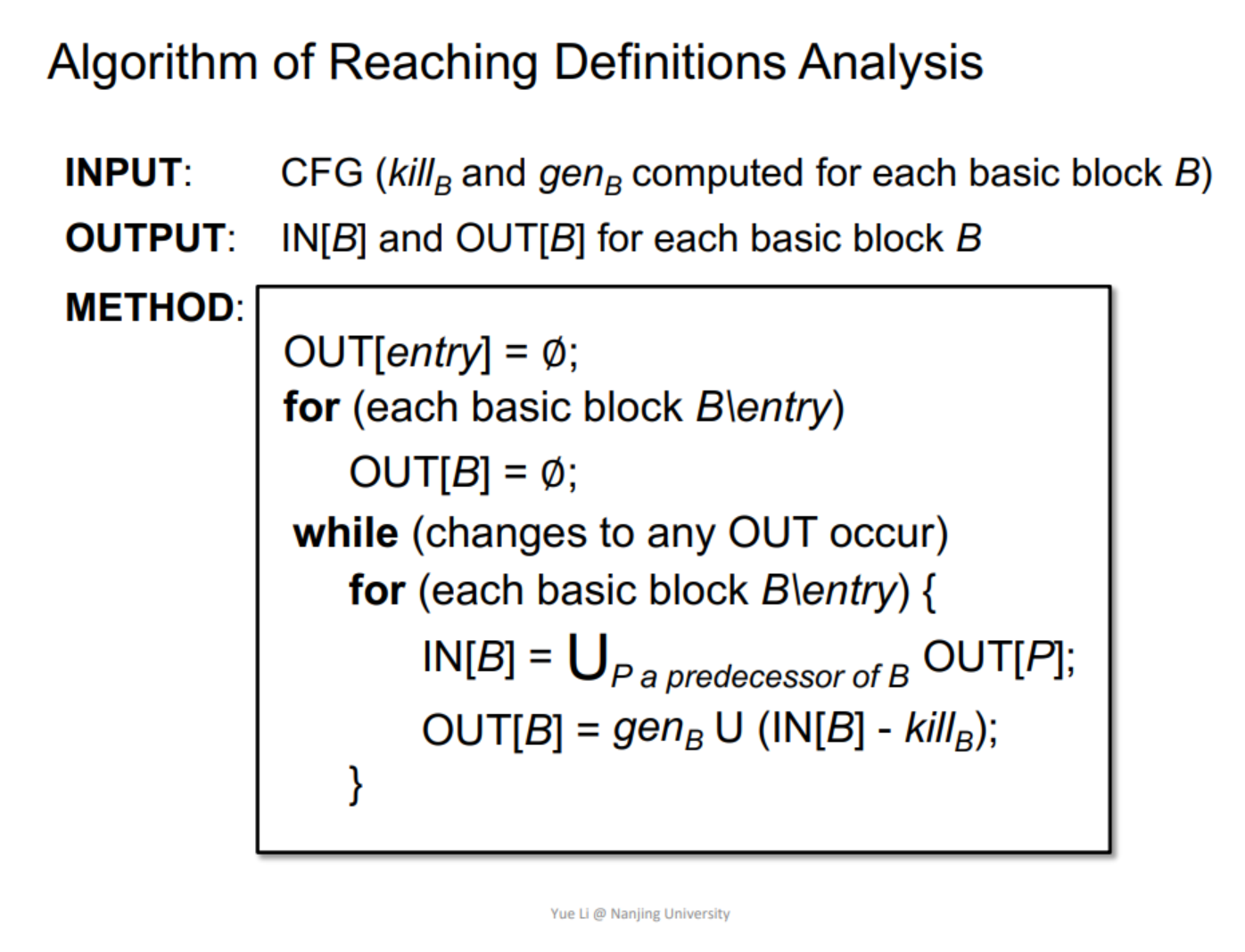
A definition d at program point p reaches a point q if there is a path from p to q such that d is not “killed” along that path
- A definition of a variable v is a statement that assigns a value to v
Translated as: definition of variable v at program point p reaches point q if there is a path from p to q such that no new definition of v appears on that path
- Reaching definitions can be used to detect possible undefined variables. e.g., introduce a dummy definition for each variable v at the entry of CFG, and if the dummy definition of v reaches a point p where v is used, then v may be used before definition (as undefined reaches v)
可以从语义的角度理解
为什么这个迭代算法会终止
OUT[S] = gens U (IN[S] - kills)
这是一个非严格递增数
- genS and killS remain unchanged
- When more facts flow in IN[S], the “more facts” either
- is killed, or
- flows to OUT[S] (survivorS)
- When a fact is added to OUT[S], through either genS, or survivorS , it stays there forever
- Thus OUT[S] never shrinks.
- As the set of facts is finite (e.g., all definitions in the program),there must exist a pass of iteration during which nothing is added to any OUT, and then the algorithm terminates