数据流分析--数据流分析理论基础
关键词
- Iterative Algorithm, Another View
- Partial Order
- Upper Bound and Lower Bound
- Lattice, Semilattice, Complete and Product Lattice
- Data Flow Analysis Framework via Lattice
- Monotonicity and Fixed Point Theorem
View Iterative Algorithm in Another Way
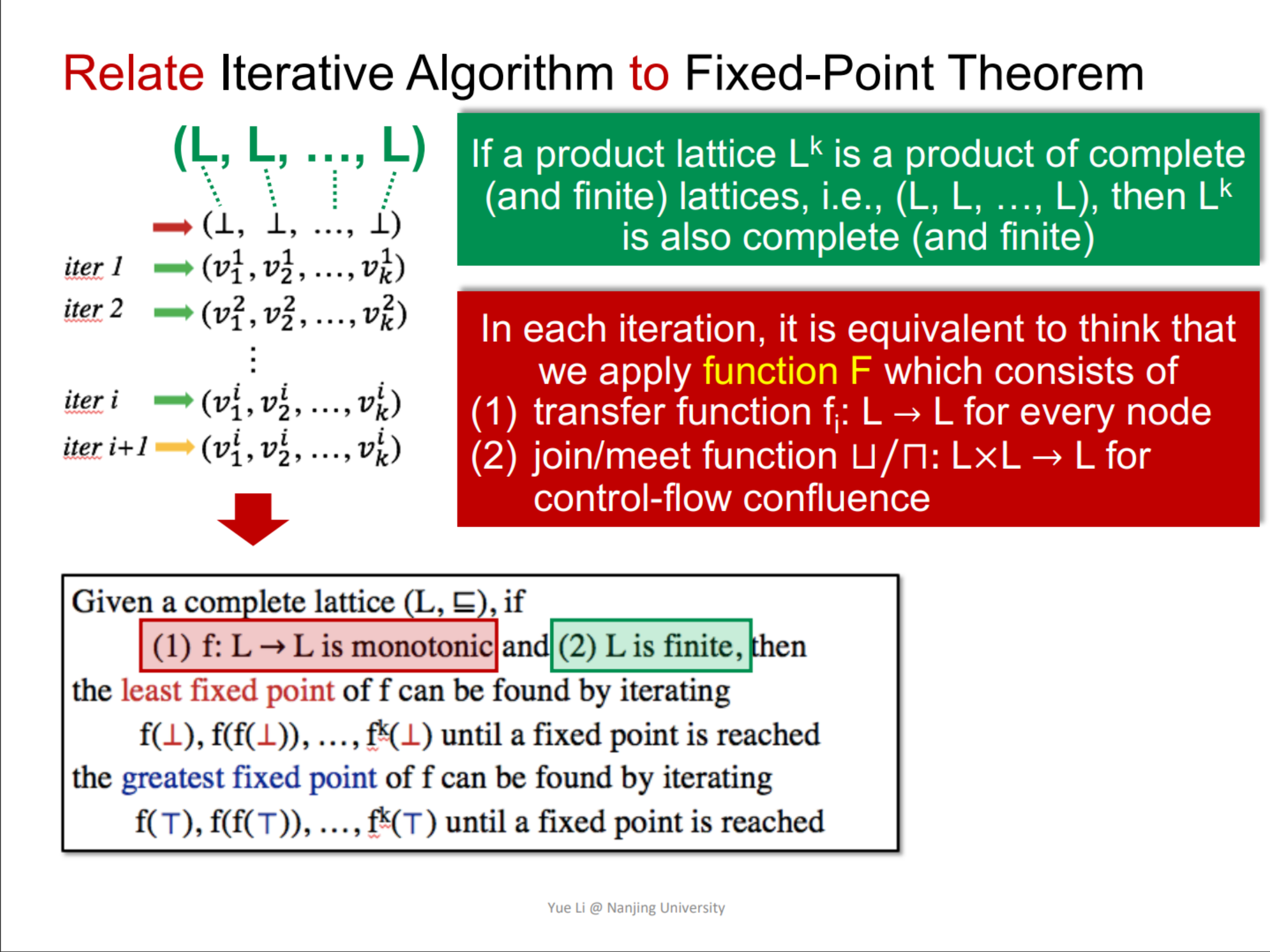
Given a CFG (program) with k nodes, the iterative algorithm updates OUT[n] for every node n in each iteration.
Assume the domain of the values in data flow analysis is V, then we can define a k-tuple as an element of set (V1 × V2 … × Vk) denoted as Vk
Each iteration can be considered as taking an action to map an element of Vk to a new element of Vk , through applying the transfer functions and control-flow handing, abstracted as a function F: Vk → Vk
Then the algorithm outputs a series of k-tuples iteratively until a k-tuple is the same as the last one in two consecutive iterations
X is a fixed point of F if F(X) = X
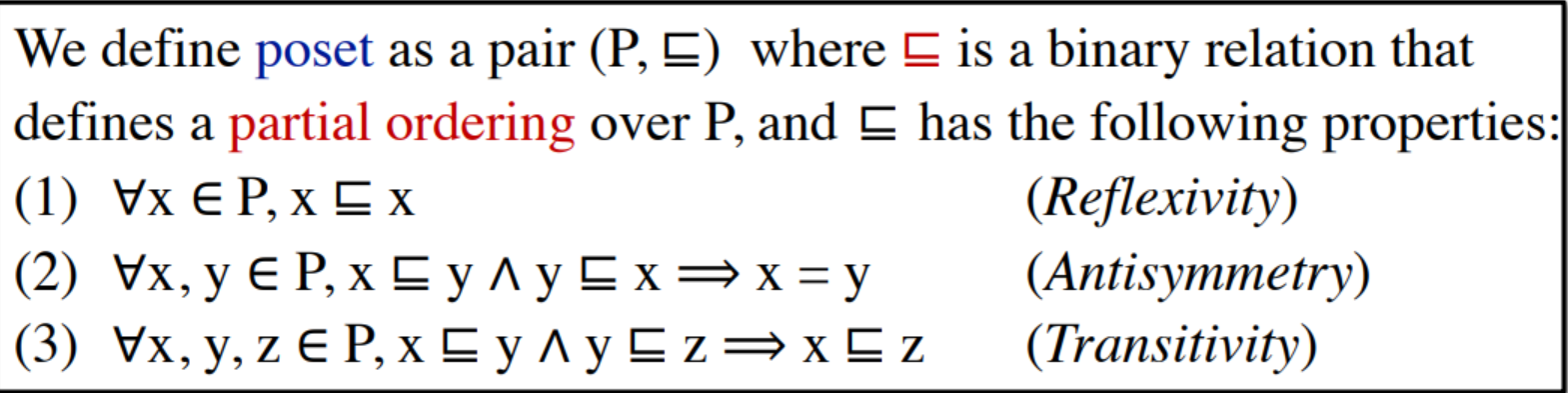
Partial Order
Upper abd Lower Bounds

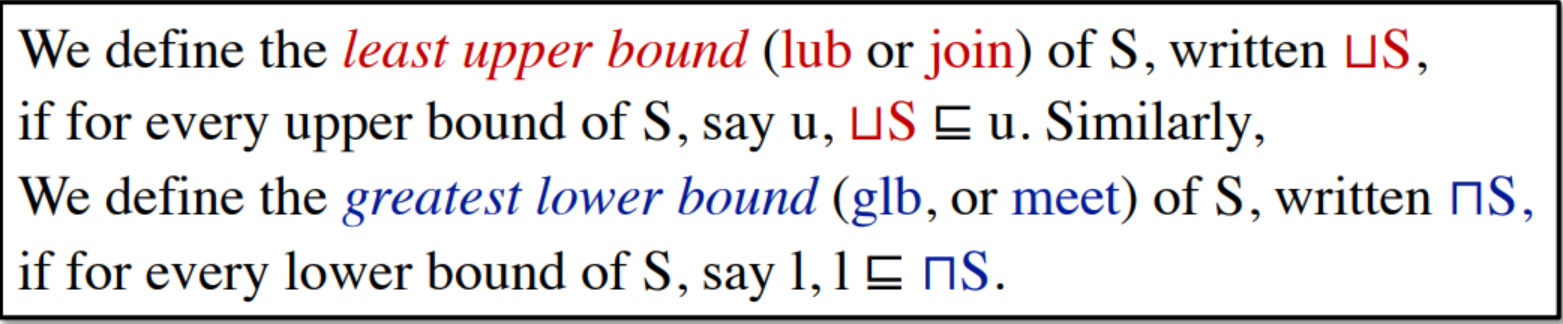
Some Properties
not every poset has lub or glb
But if a poset has lub or glb it will be unique
通过反对称性可证
Lattice
A poset (V, ≤) is a lattice if every pair of elements in V has both a lub and a glb.
Semilattice
if only lub exists,then P is called a join semilattice.
if only glb exists,then P is called a meet semilattice.
Complete Lattice
A poset (V, ≤) is a complete lattice if every subset of V has both a lub and a glb.
Every complete lattice P has a greatest element (denoted as ⊤) and a least element (denoted as ⊥).
Every finite lattice is a complete lattice.
程序分析关注的通常是有穷的complete lattice.
Product Lattice(直积格)
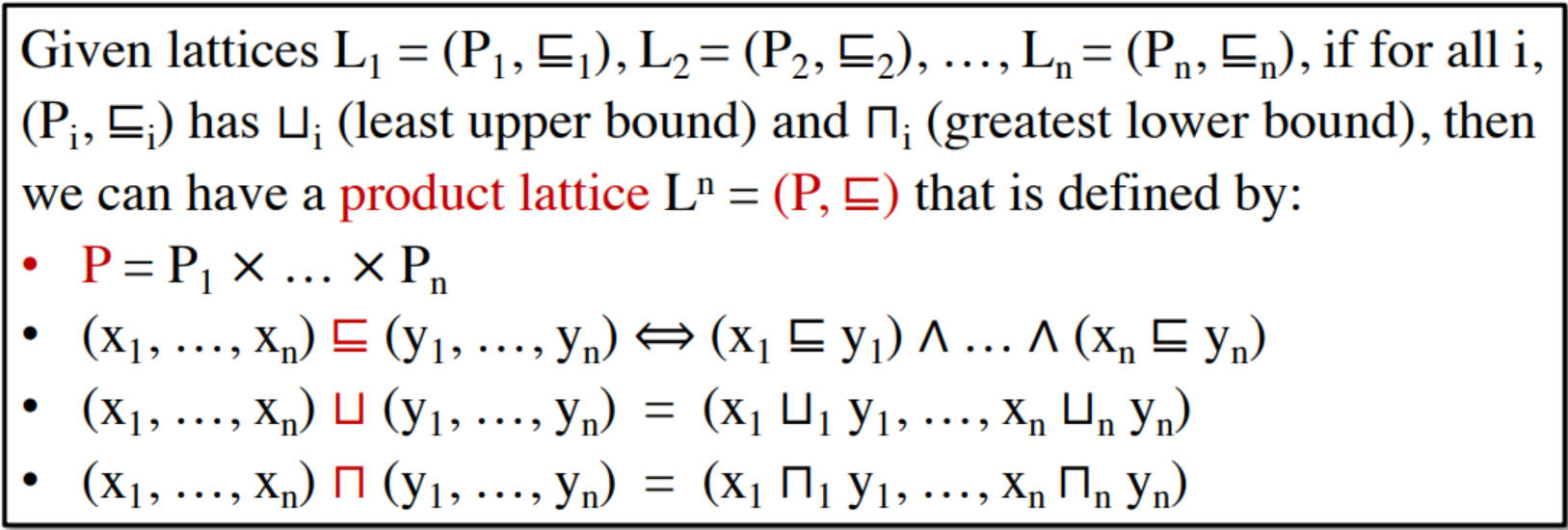
A Product lattice is a lattice.
if a product lattice L is a prouct of complete lattices, then L is alse complete.
Data Flow Analysis Framework via Lattice
A data flow analysis framework (D, L, F) consists of:
D: a direction of data flow: forwards or backwards
L: a lattice including domain of the values V and a meet ⊓ or join ⊔ operator
F: a family of transfer functions from V to V
Data flow analysis can be seen as iteratively applying transfer functions and meet/join operations on the values of a lattice.
Monotonicity and Fixed Point Theorem
Monotonicity: onotonicity A function f: L → L (L is a lattice) is monotonic if ∀x, y ∈ L, x ⊑ y ⟹ f(x) ⊑ f(y)
Fixed Point Theorem: Given a complete lattice (L, ⊑), if
(1) f: L → L is monotonic
(2) L is finite
the least fixed point of f can be found by iterating f(⊥), f(f(⊥)), …, fk(⊥) until a fixed point is reached
the greatest fixed point of f can be found by iterating f(⊤), f(f(⊤)), …, fk(⊤) until a fixed point is reached.
1
2
3
4
5
6
7
8
9
10
11
12
13
14
15
16
17
18
19
20
21
22
23
24
25
26
Proof:
By the definition of ⊥ and f: L → L, we have

⊥ ⊑ f(⊥)

As f is monotonic, we have
f(⊥) ⊑ f(f(⊥)) = f2(⊥)

By repeatedly applying f, we have an ascending chain

⊥ ⊑ f(⊥) ⊑ f2(⊥) ⊑ … ⊑ fi
(⊥)

As L is finite (its height is H), the values are bounded among

⊥ , f(⊥) , f2(⊥) … fH(⊥)

When i > H, by pigeonhole principle, there exists k and j that

fk(⊥) = fj(⊥) (assume k < j ≤ H+1)

Further as fk(⊥) ⊑ … ⊑ fj
(⊥) (monotonicity of f), we have
fFix = fk(⊥) = fk+1(⊥)=...fj(⊥)(proof by contradiction)

Thus, the fixed point exists.
Least Fixed Point proof
1
2
3
4
5
6
7
8
9
10
11
12
13
14
15
16
17
18
19
Proof:
Assume we have another fixed point x, i.e., x = f(x)

By the definition of ⊥, we have ⊥ ⊑ x

Induction begins:
As f is monotonic, we have f(⊥) ⊑ f(x)

Assume fi(⊥) ⊑ fi(x), as f is monotonic, we have
fi+1(⊥) ⊑ fi+1(x)

Thus by induction, we have
fi(⊥) ⊑ fi(x)

Thus fi(⊥) ⊑ fi(x) = x (as x is a fixed point regardless of i),
then we have
fFix = fk(⊥) ⊑ fk(x) = x

Thus the fixed point is the least.
Relate Iterative Algorithm to Fixed Point Theorem
Proof Function F is Monotonic
In each iteration, it is equivalent to think that we apply function F which consists of
- (1) transfer function fi
- L → L for every node
(2) join/meet function ⊔/⊓: L×L → L for control-flow confluence
1
2
3
4
5
6
7
Proof:
∀x, y, z ∈ L, x ⊑ y, we want to prove x ⊔ z ⊑ y ⊔ z
by the definition of ⊔, y ⊑ y ⊔ z
by transitivity of ⊑, x ⊑ y ⊔ z
thus y ⊔ z is an upper bound for x, and also for z (by ⊔’s definition)
as x ⊔ z is the least upper bound of x and z
thus x ⊔ z ⊑ y ⊔ z
When will the Algotithm Reach the fixed Point?
The height of a lattice h is the length of the longest path from Top to Bottom.
In each iteration, assume only one step in the lattice (upwards or downwards) is made in one node (e.g., one 0->1 in RD)
Assume the lattice height is h and the number of nodes in CFG is k
We need at most i = h*k iterations.
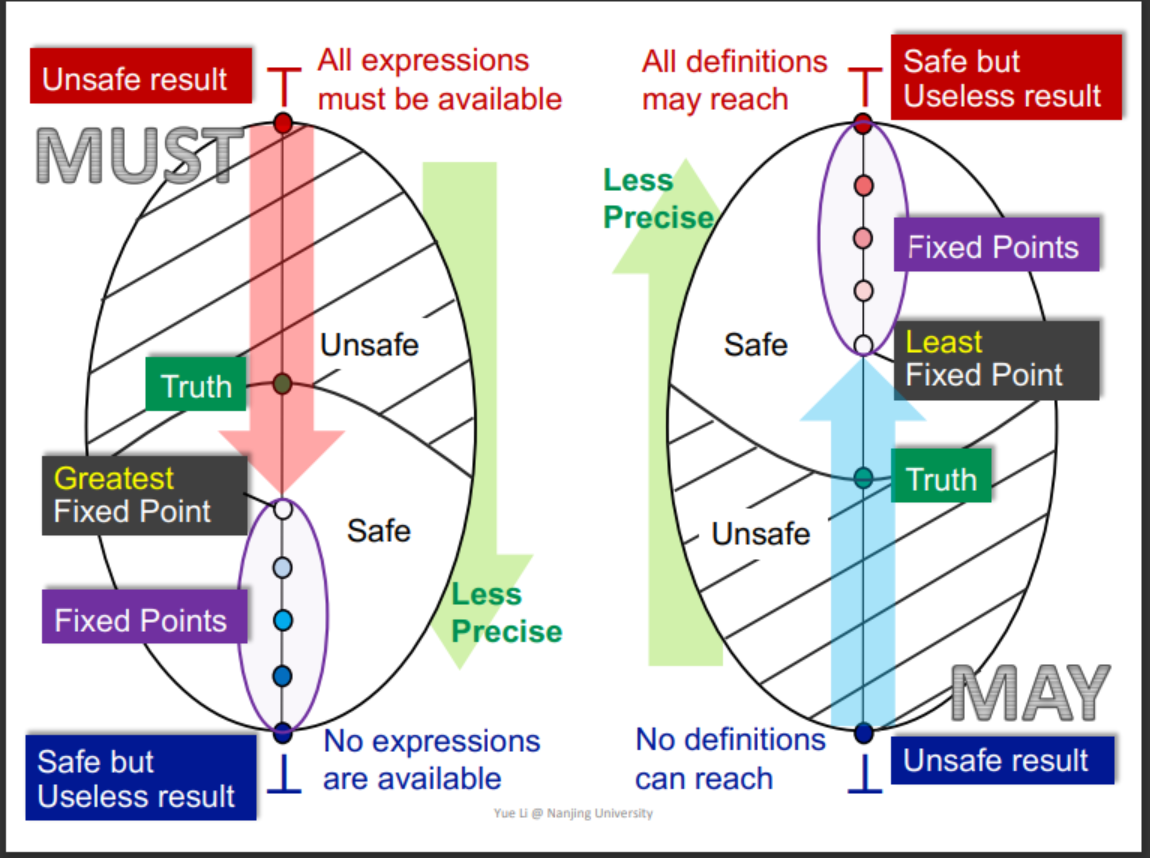
May and Must Analyses, a Lattice View
How Precise is Our Solution?
Meet-Over-All-Paths Solution (MOP):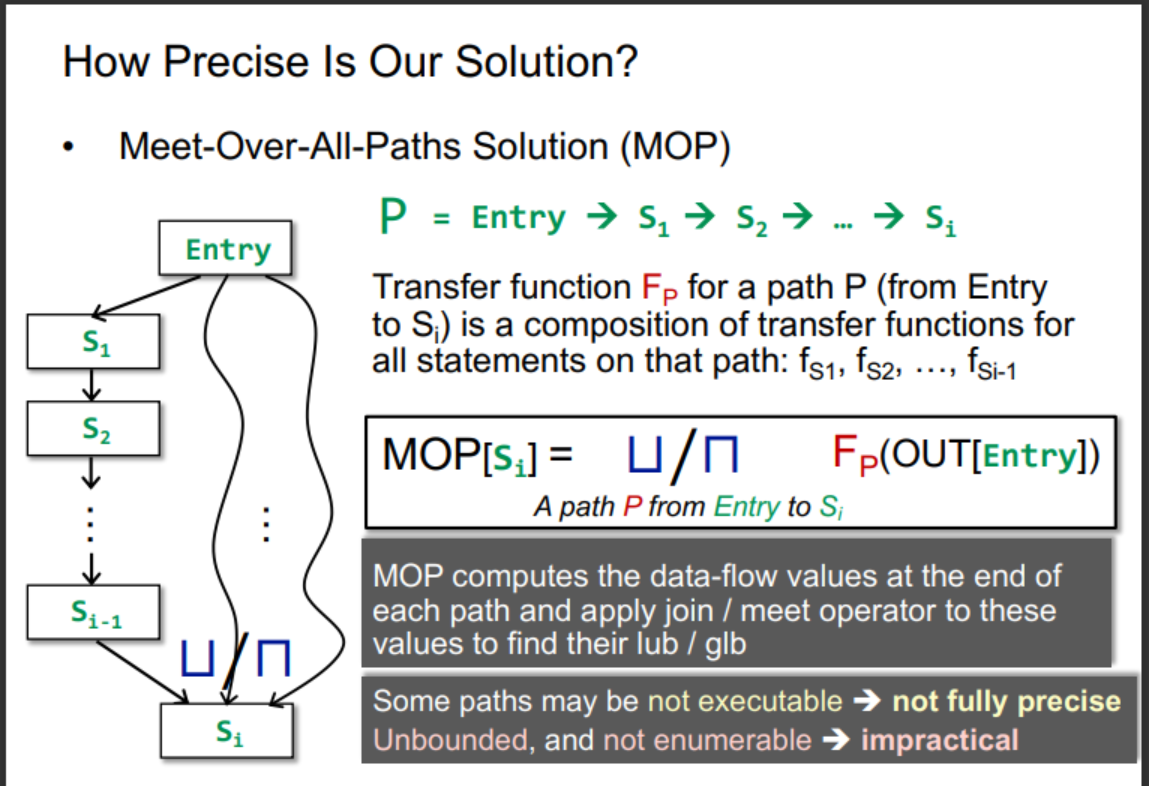
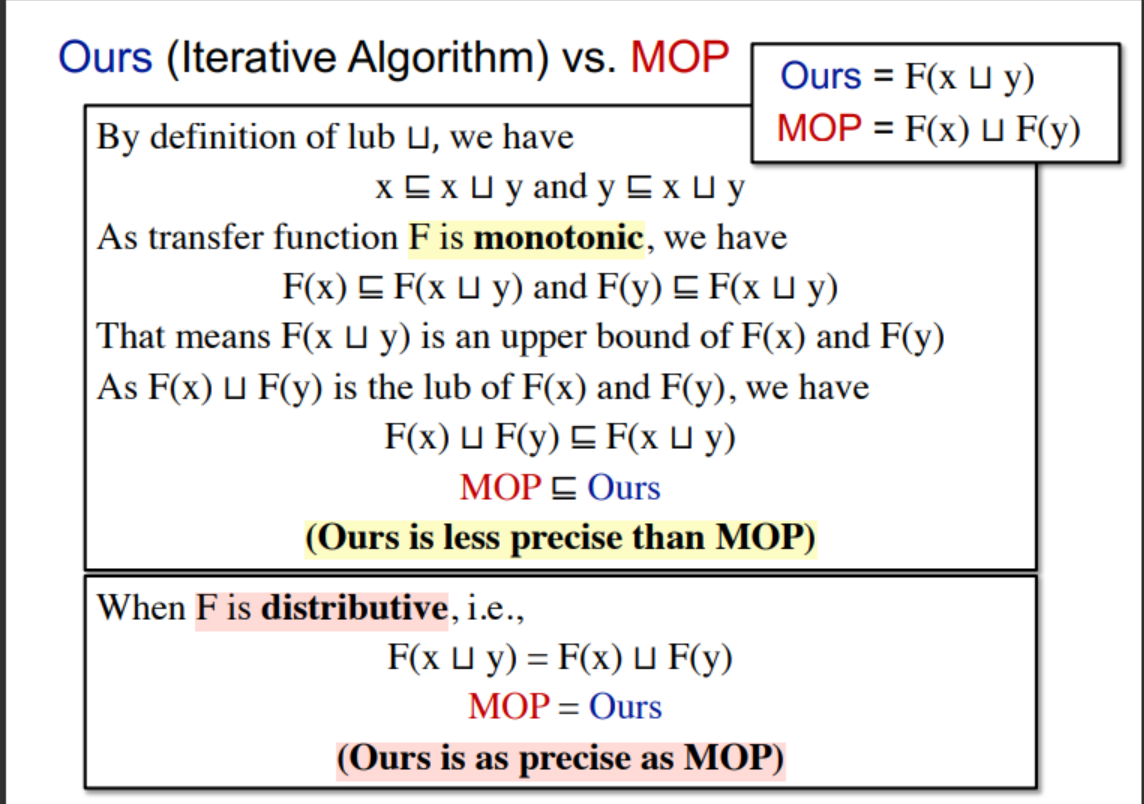
Iterative Algorithm vs. MOP
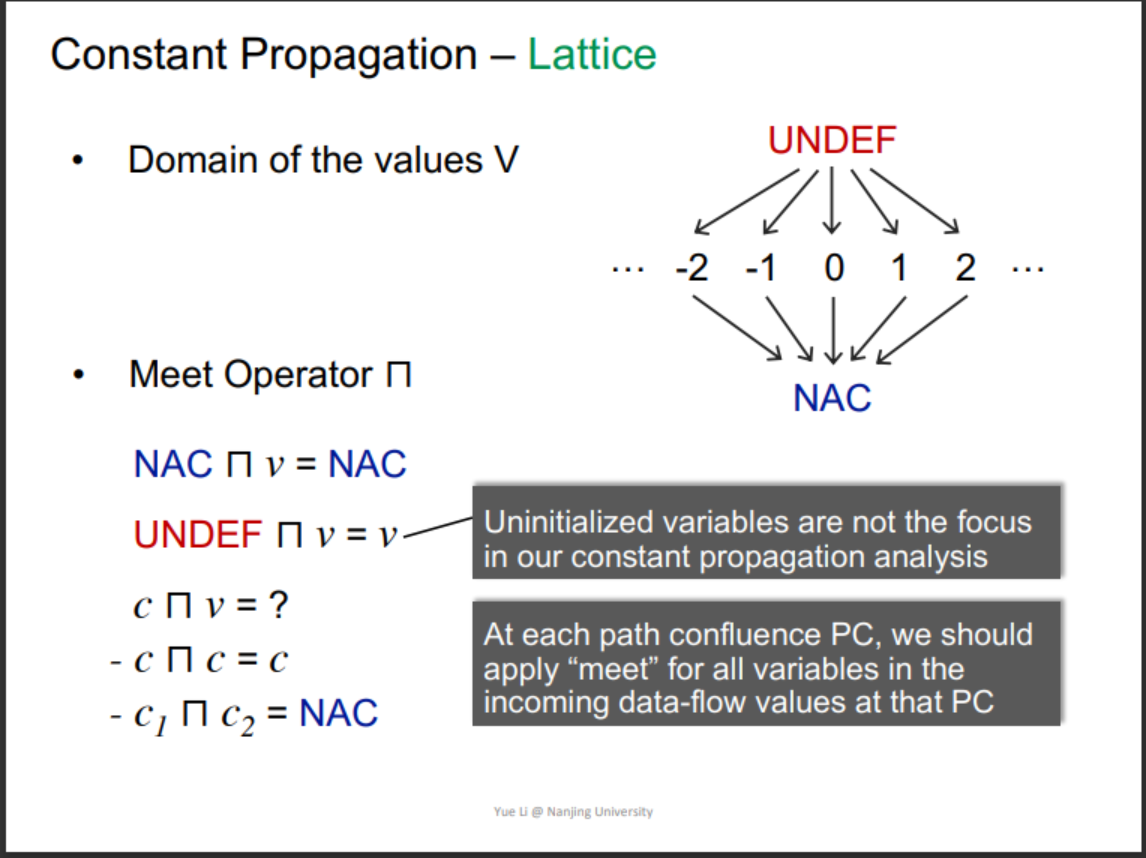
Constant Propagation
Given a variable x at program point p,determine whether x is guaranteed to hold a constant value at p.
The OUT of each node in CFG, includes a set of pairs (x,v) where x is a variable and v is a value held by x after that node.
A data flow analysis framework (D, L, F) consists of:
• D: a direction of data flow: forwards or backwards
• L: a lattice including domain of the values V and a meet ⊓ or join ⊔ operator
• F: a family of transfer functions from V to V
Transfer Function
Given a statement s: x=…, we define its transfer function F as
F: OUT[s] = gen ∪ (IN[s] – {(x, _)})
(we use val(x) to denote the lattice value that variable x holds)
• s: x = y; gen = {(x, val(y))}
• s: x = y op z; gen = {(x, f(y,z))}
f(y,z) =
val(y) op val(z) // if val(y) and val(z) are constants
NAC // if val(y) or val(z) is NAC
UNDEF // otherwise(if s is not an assignment statement, F is the identity function)
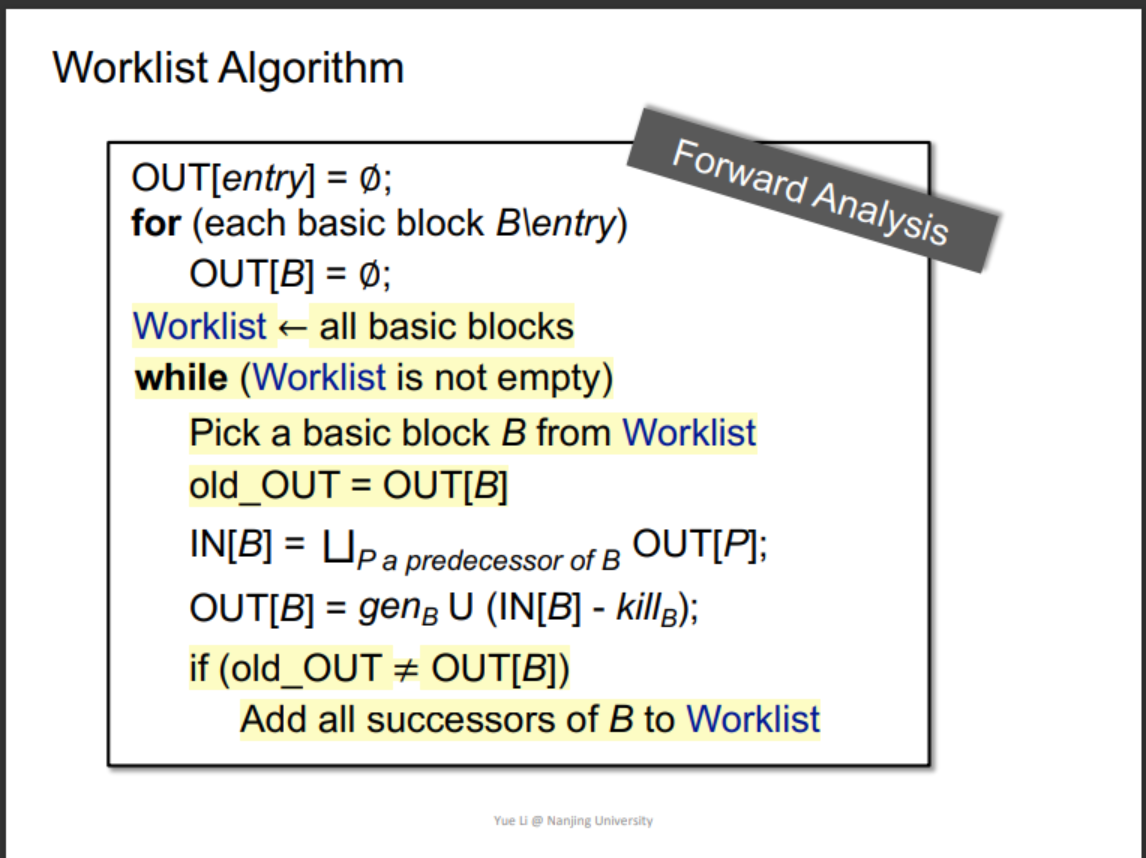
Worklist Algorithm
an optimization of the iterative algorithm