数据流分析--应用II
关键词
- Live Variables Analysis
- Available Expressions Analysis
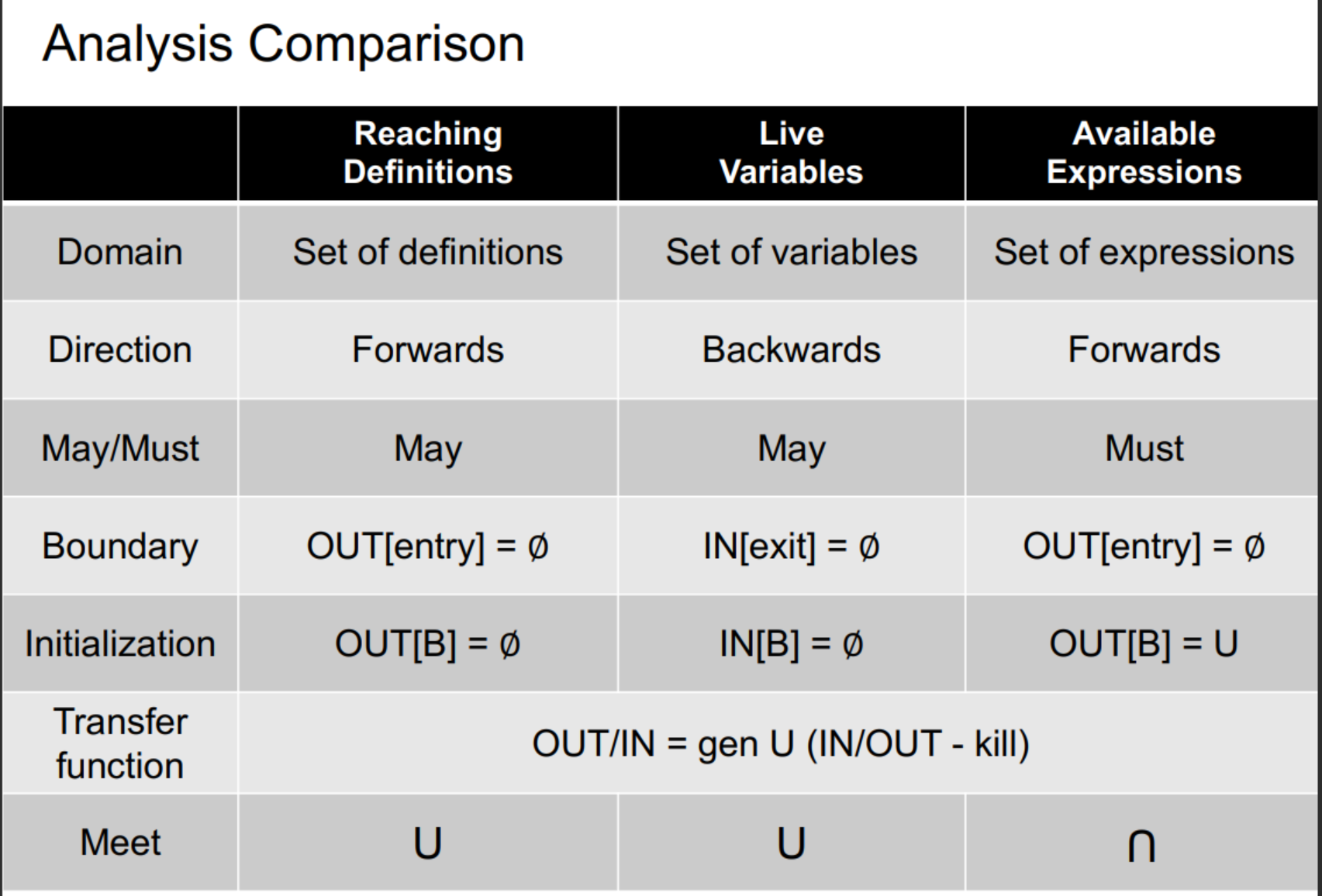
- Analysis Comparison
Live Variables Analysis
Live variable analysis tells whether the value of variable v at program point p could be used along some path in CFG starting at p. If so, v is live at p; otherwise, v is dead at p.
显然是may analysis.
Abstraction:use bit vectors represented the live variables at each program point.
使用反向分析比较合适.
Transfer Function
OUT[B] = Union of IN[S] for all successors S of B
IN[B] = USE[B] U (OUT[B] - DEF[B])
转换函数是如何区分先定义后使用和先使用后定义的?构造 USE[B]、DEF[B] 时,不是简单地“块里所有用到的变量”和“块里所有定义的变量”。它们有一个 扫描顺序:从基本块的入口往出口顺序扫描指令:如果遇到 x = … 且 x 还不在 DEF[B] 中,那么把 x 加入 DEF[B]。如果在扫描时用到了某个变量 y,并且 y 还没在 DEF[B] 中(即这个块内还没有在它之前定义过),那么把 y 加入 USE[B]。这意味着:如果一个变量在块中先用后定义,那么它会被加入到 USE[B](因为用的时候还没被定义)。如果一个变量在块中先定义后使用,那么这个变量不会出现在 USE[B] 里(因为使用的时候入口的值已经被覆盖掉了)。
Algorithm-Live Variables Analysis
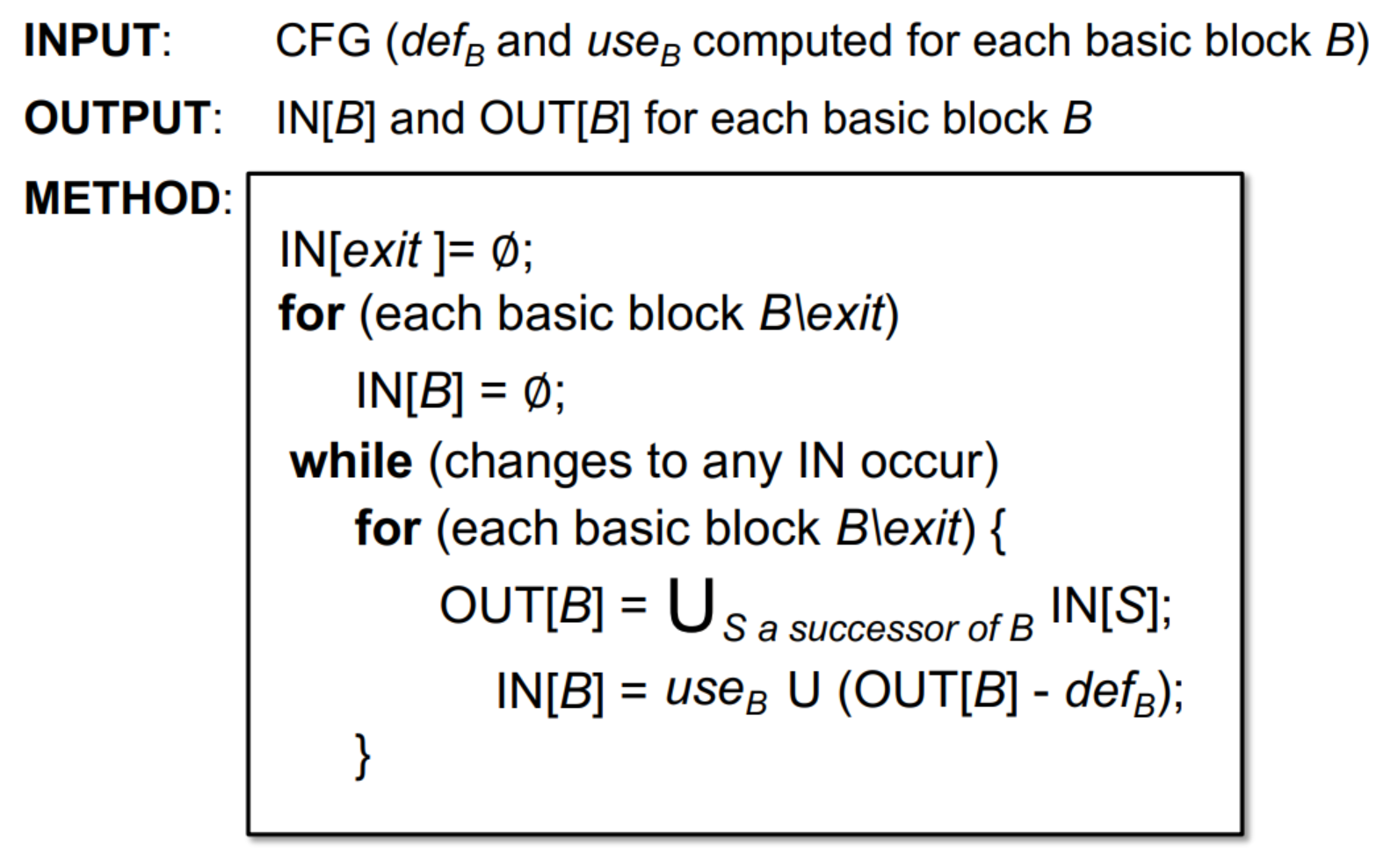
useB 和 defB 是不变的,如果out[B] 增大则IN[B] 一定增大,又因为存在上界,所以算法一定收敛.
Available Expressions Analysis
An expression x op y is available at program point p if (1) all paths from the entry to p must pass through the evaluation of x op y, and (2) after the last evaluation of x op y, there is no redefinition of x or y
显然是must analysis.前向分析
例
1
a = b + c
Add to OUT the expression x op y (gen) • Delete from IN any expression involving variable a (kill)
OUT[B] = GEN[B] U (IN[B] - KILL[B])
IN[B] = Intersection of OUT[P] for all predecessors P of B
All paths from entry to point p must pass through the evaluation of x op y
Algorithm-Available Expressions Analysis
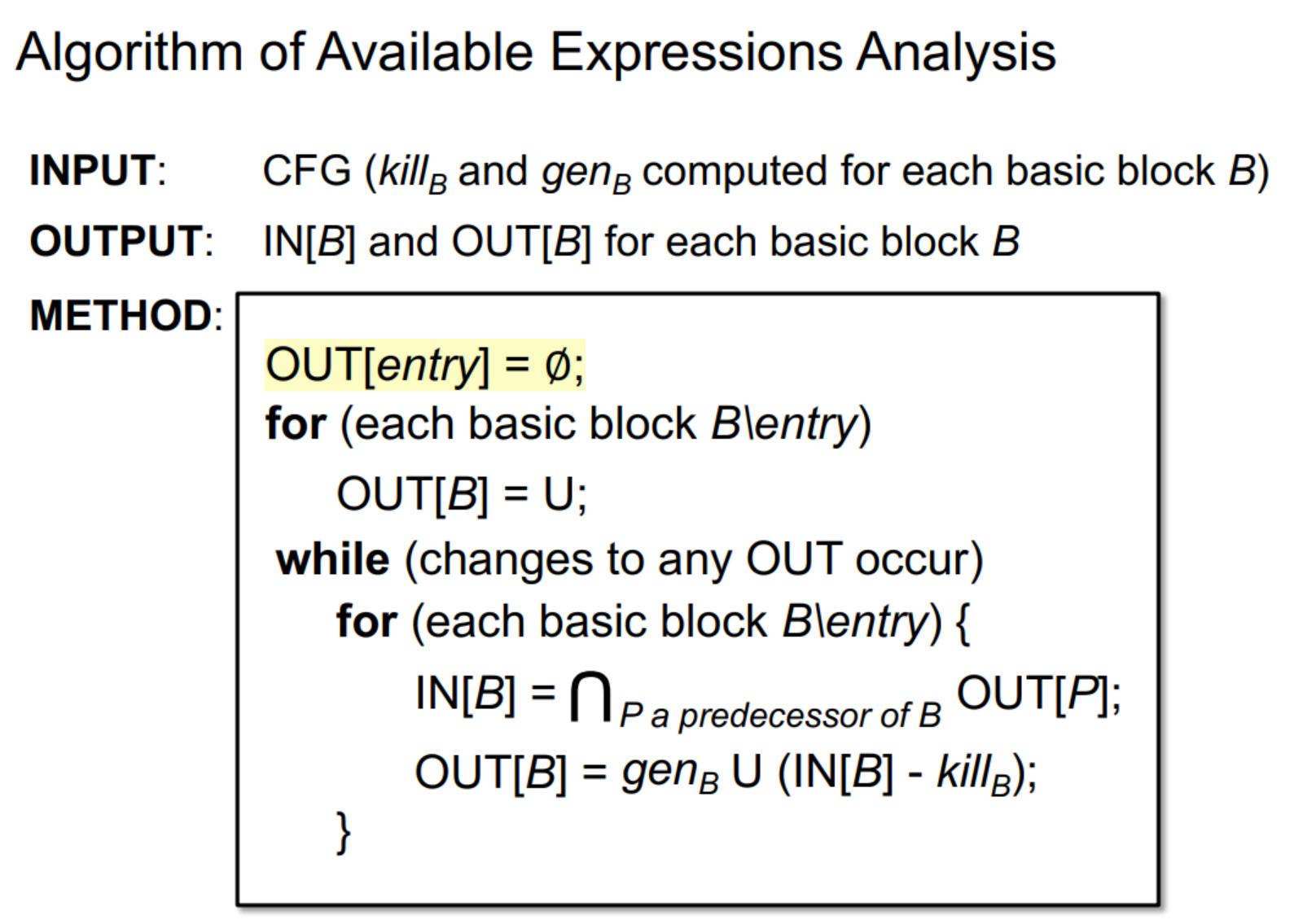
在可用表达式分析中,谁后出现谁说了算:先 kill 再 gen ⇒ 可用,先 gen 再 kill ⇒ 不可用。
因为kill和gen不变,如果IN[B] 减小则OUT[B] 一定减小,又因为存在下界,所以算法一定收敛.
Analysis Comparison