数据流分析--过程间分析
Main content
- Motivation
- Call Graph
- Interprocedural Control-Flow Graph
- Interprocedural Data-Flow Analysis
- Interprocedural constant propagation
Motivation
过程内分析(Intraprocedural analysis) Make the most conservative assumption for method calls,for safe-approximation Source of imprecision.
过程间分析(Interprocedural analysis) propagate data-flow information along interprocedural control-flow edges.
Call Graph
a representatioin of calling relationships in the program.
Applications:
Foundation of all interprocedural analysis.
debug
test
Call Graph COnstruction for OOPLs (focus on Java):
Class hierachy analysis(CHA)
Rapid type analysis(RTA)
Variable type analysis(VTA)
pointer analysis(k-CFA)
从上到下:效率到精确
Method call(Invocation) in Java
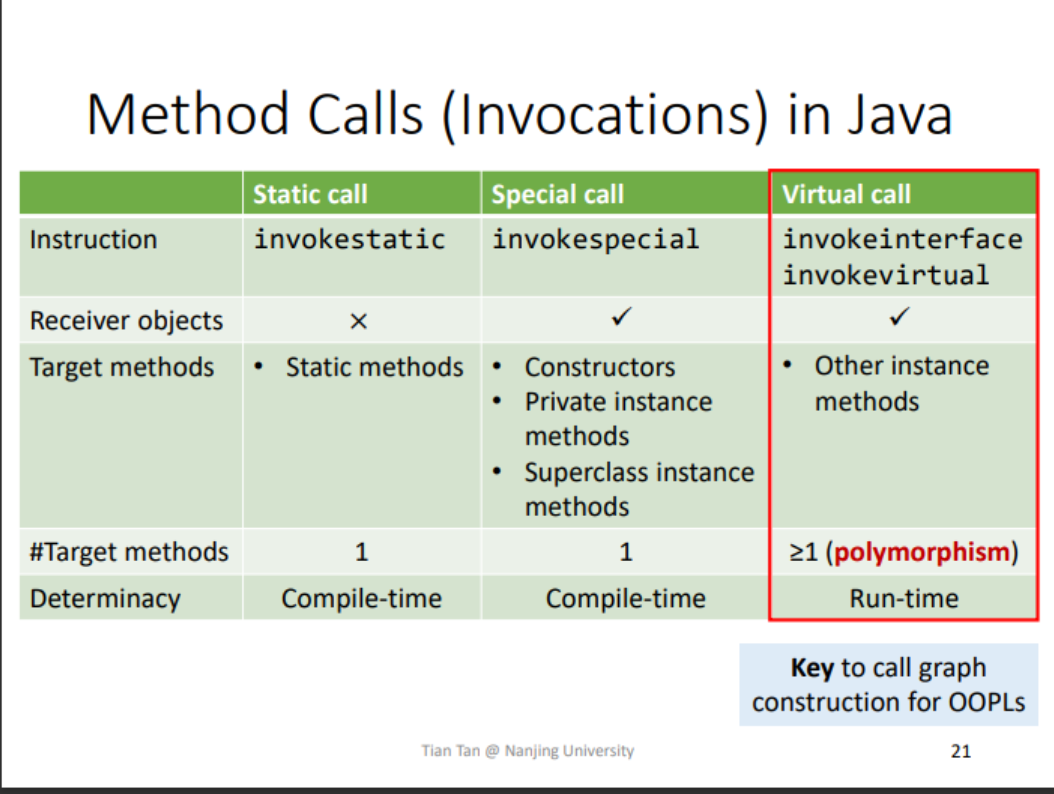
Method Dispatch of Virtual Calls
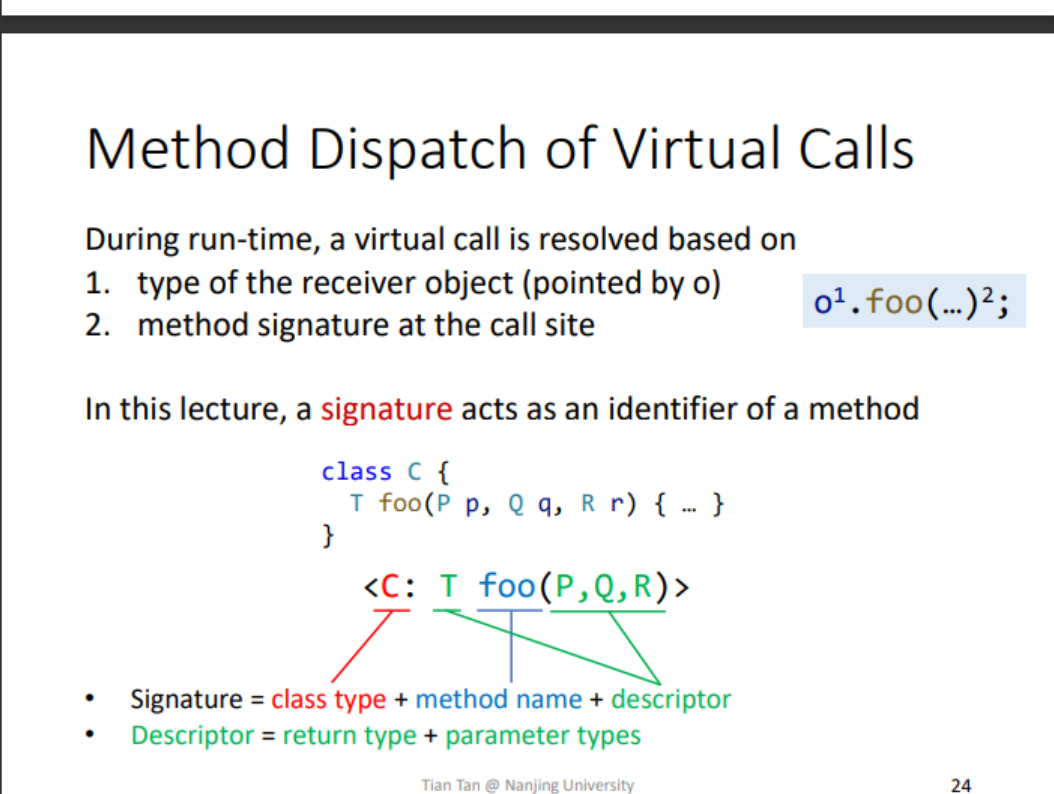
use C.foo(P,Q,R) for short.
procedure of Dispatch
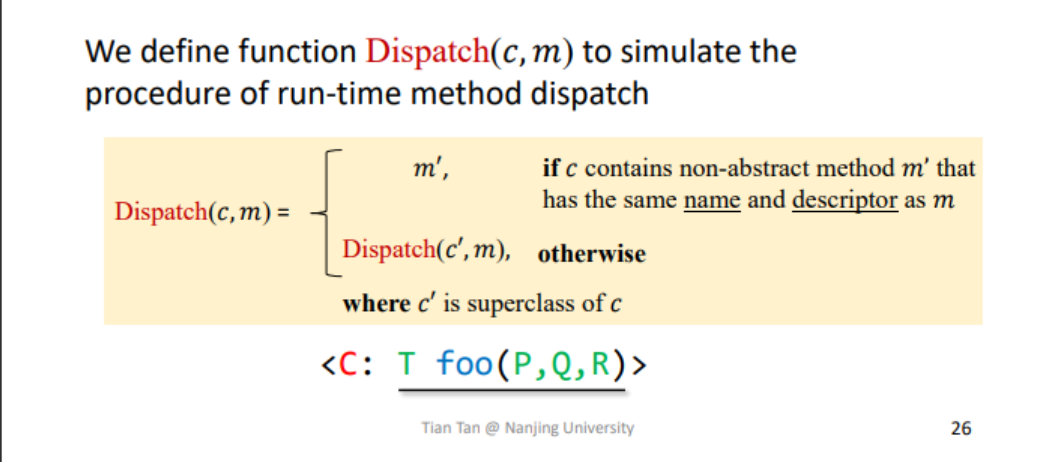
Class Hierarchy Analysis(CHA)
Require the class hierarchy information (inheritance structure) of the whole program
Resolve a virtual call based on the declared type of receiver variable of the call site
1
2
A a = ...
a.foo();
Assume the receiver variable a may point to objects of class A or all subclasses of A
Resolve target methods by looking up the class hierarchy of class A
Call Resolution of CHA
We define function Resolve(cs) to resolve possible target methods of a call site cs by CHA
1
2
3
4
5
6
7
8
9
10
11
12
13
Resolve(cs)
    T = {}
    m = method signature at cs
    if cs is static call then
        T = {m}
    if cs is special call then
        c^m = class type of m
        T = {Dispatch(c^m, m)}
    if cs is virtual call then
        c = declared type of receiver variable at cs
        for each class c' that is a subclass of c or c itself do
            add Dispatch(c',m) to T
    return T
Feature of CHA
- Advantage: fast
- Only consider the declared type of receiver variable at the call-site, and its inheritance hierarchy
- Ignore data- and control-flow information
- Disadvantage: imprecise
- Easily introduce spurious target methods
- Addressed in next letures
Call Graph Construction
Build call Graph for whole progarm via CHA
Start from entry methods (focus on main method)
For each reachable method m, resolve target methods for each call site cs in m via CHA(Resovle(cs))
Repeat untiol no new method is discovered
BuildCallGraph(m^entry)
  WL = [m^entry]
  CG = {}
  RM = {}
  while WL is not empty do
    remove m from WL
    if m not in RM then
        add m to RM
        for each call site cs in m do
            T = Resolve(cs)
            for each target method m' in T do
              add cs -> m' to CG
              add m' to WL
    return CG

WL: Work list, containing the methods to be processed

CG: Call graph, a set of call edges

RM: A set of reachable methods
Interprocedural Control-Flow Graph
CFG represents structure of an individual method
ICFG represents structure of the whole program
An ICFG a preogram consists of CFGs of the methods in the program, plus two kinds of additional edges:
Call edges: from a call site to the entry node of the target method
Return edges: from exit node of a method to the statement following the call site
ICFG = CFG + call & return edges
Interprocedural Data-Flow Analysis
过程内分析建立在控制流图上,需要节点内转换函数
过程间分析建立在过程间控制流图上,需要node transfer+edge transfer
Edge transfer:
Call edge transfer: transfer data flow from call site to the entry node of callee (along call edges)
Return edge transfer: transfer data flow from exit node of the callee to the return site (along return edges)
Interprocedural Constant Propagation
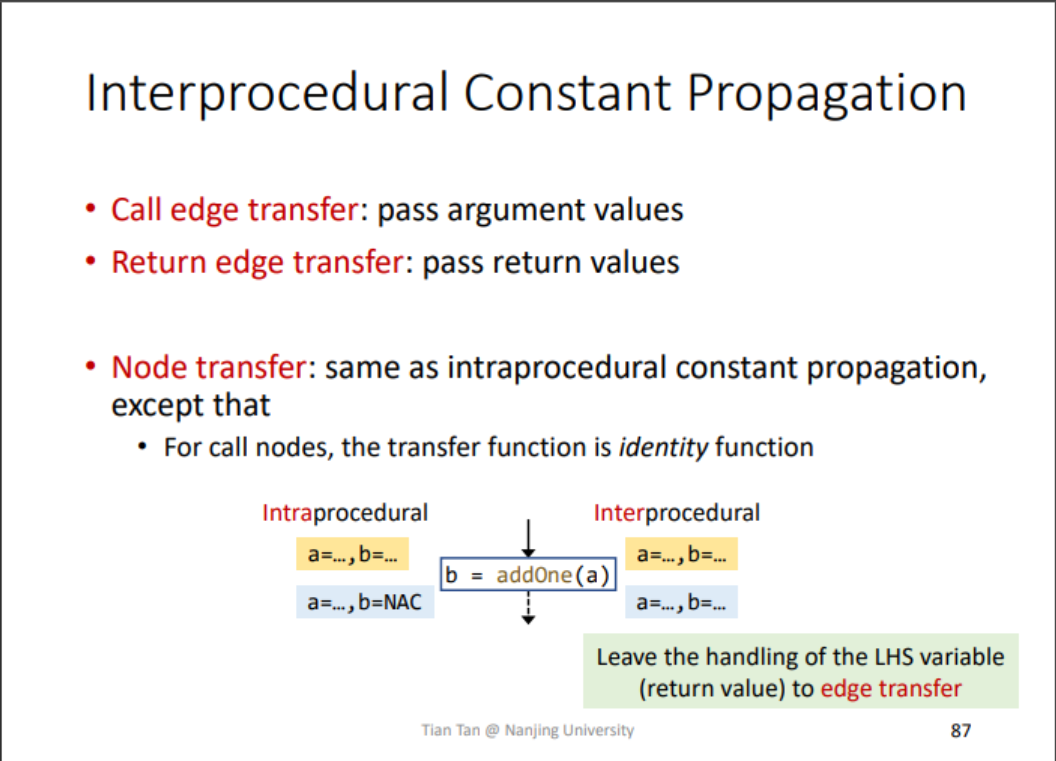
Call-to-return edges allow the analysis to propagate local data-flow.
for call-to-return edge,kill the value of the LHS variable of the call site. Its value will flow to return site along the return edges. Otherwise, it may cause imprecision.